

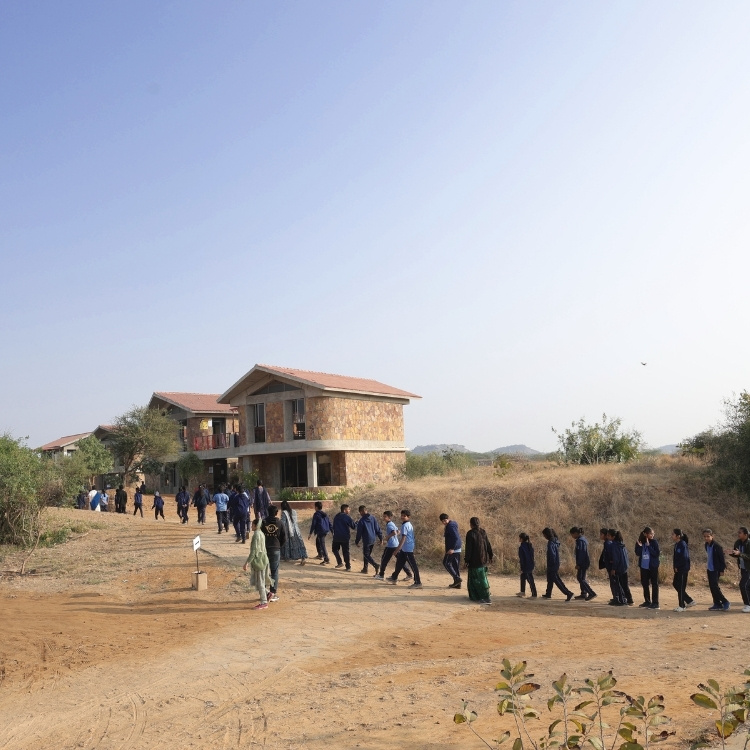
Approach
Learning Beyond Boundaries
Children by nature are curious and interested in learning. Our role is to create a rich and nurturing environment in which their curiosity can flourish and their potential can unfold.
Our approach to education is one of learning through understanding and doing. Physical spaces are provided in Maths and Science for conceptual explorations, which are then firmed up through problem solving and computational skills. In the early years, language learning grows naturally through songs, stories and conversation, and is gradually strengthened through phonics, vocabulary building and reading. A love of books is nurtured from an early age, alongside the systematic development of grammar, comprehension and writing skills.
Through our Social Studies programme, children are encouraged to think critically about ideas such as democracy, nationalism, equality, fairness and the nature of a capitalist economy. They also explore issues such as poverty, environmental degradation and diversity, developing not only an understanding of these complex questions but also an empathetic perspective towards the people and communities affected by them.
Music, dance, art, farming, nature walks, tinkering and design, swimming, cycling, sports are all an integral part of the curriculum rather than added on as extracurricular. We believe that children learn through their hands, bodies, senses, imagination and relationships just as much as they learn through books and classrooms.
The mode of learning is through inquiry, exploration, experimentation, dialogues and discussions, nature study, project work and field trip.
Conflict and behavioural issues amongst children are handled through dialogue and natural consequences rather than punishment. There are lots of age-appropriate opportunities for children to take up various responsibilities in the school and they take charge of the upkeep of their personal spaces.
Through our Social Studies programme, children are encouraged to think critically about ideas such as democracy, nationalism, equality, fairness and the nature of a capitalist economy. They also explore issues such as poverty, environmental degradation and diversity, developing not only an understanding of these complex questions but also an empathetic perspective towards the people and communities affected by them.
The mode of learning is through inquiry, exploration, experimentation, dialogues and discussions, nature study, project work and field trips. Music, dance, art, farming, nature walks, tinkering, swimming, cycling, sports, inquiry are all an integral part of the curriculum rather than added on as extracurricular. We believe that children learn through their hands, bodies, imagination and relationships just as much as they learn through books and classrooms.
Exams are not regarded as a monster to be slayed; our assessment system, which is unobtrusive and non-comparative facilitates the natural growth of the child. Children are given opportunities for self assessment, and feedback is qualitative rather than quantitative up to class eight, allowing teachers and children to focus on what has been understood, what remains to be explored and how learning can progress.
Parallelly, discussion and dialogues take place to put the board exams in its right perspective. There are of course societal pressures that play a role in magnifying these fears, but with support from well meaning adults in the community they are able to pass through this phase relatively easily.
Conflict and behavioural issues amongst children are handled through dialogue and natural consequences rather than punishment. There are lots of age appropriate opportunities to take up various responsibilities in the school.
The school should be a place where you are helped to find out for yourself through talking, through discussion, through study, through examination, through listening, through silence, to find out, right through your life, what you really love to do.
-J Krishnamurti
Our Philosophy
An Environment of Freedom and Fearlessness
Shishukunj International School, Bhuj works with children in order to emphasize the holistic development of each individual child which includes physical, mental, social, emotional and spiritual aspects by creating a fearless, friendly and conducive environment for learning. It believes in the philosophy of:
“No Competition, No Comparison; No Punishments, No Rewards.”
The school’s endeavor is to unfold potentials of individuals and encourage them to be lifetime learners.

The Seed Bank Initiative
Learning with Nature, Growing Together
Recently the school undertook a project to collect seeds from students and to establish a seed bank for the school site. Students brought seeds from their homes and also collected seeds of neem tree from farms. It was also decided to broadcast local plant species of Kachchh, like pilu, desi bavar, khakhro, garmado, gulmohar, bordi, etc. Seed pallets were prepared with the help of experts, which were broadcasted after the first monsoon shower. Children, staff and workers at the school site enthusiastically participated in this event and wished that it would be totally a green area where everyone can connect with Mother Nature and preserve the local ecosystem of Kachchh.
Visit to SIS Indore
Learning Beyond Boundaries
In mid October, senior students of SIS Bhuj had an opportunity to visit our sister school, The Shishukunj International School Indore. The trip comprised of many scholastic and co-scholastic interesting activities with the students of SIS Indore. The afternoons and evenings were loaded with fun and learning by exploring historical places around the city. Each and every moment turned out to be a great opportunity to observe, learn, explore and experience the minute planning on the part of the SIS family.
Kindness in Action
Joy of Giving – Daan Utsav
In the Joy of Giving Week, our students also celebrated Daan Utsav and started a collection drive for various items in the school. 10 different categories of items, ranging from cloths, utensils, medicines, toys, books etc. were collected and distributed in the slums of Bhuj.